


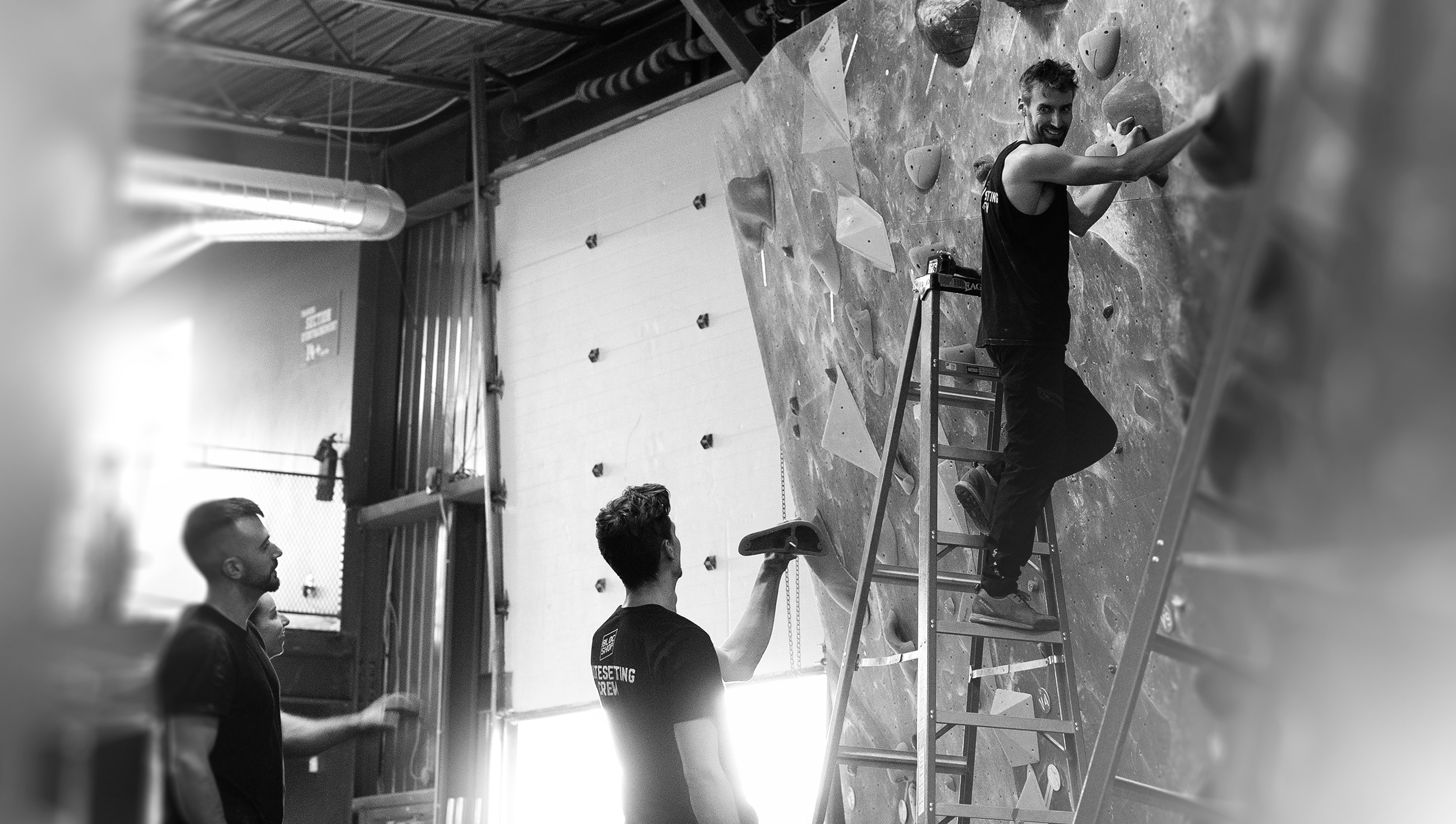
Every time you go climbing, new problems appear on the walls of your gym. These creations are the work of route setters, who must find ways to challenge you without putting you at risk. A brief conversation with Fred Charron, who has been setting problems for 20 years.
In the early 2000s, in many commercial gyms, climbers would bolt holds onto the walls in exchange for a monthly pass. In other words, almost anyone could grab a drill and put holds on a wall to create a “problem.” The result? Routes that were sometimes strange or even dangerous, holds that were occasionally painful and not always properly secured. In short, not necessarily an inviting experience for everyone.
Today, things have changed dramatically. There are now formal training programs for route setters, the practice has become professionalized, and teamwork plays a key role in ensuring that movements are interesting and varied.
Fred has spent the past two decades screwing holds on and off, testing, adjusting, and above all, observing how the craft has evolved.
“In the beginning, we mostly worked with what we had,” Fred recalls. Fewer volumes. Less variety in holds. The walls themselves were simpler. Route setting was closely tied to raw performance, and setters learned on the job, without structured training. Problems were built around positive holds and direct movement and certainly not coordination moves.
One thing that has truly changed, Fred Charron notes, is the standard in terms of quality and expectations for problems, both in competitions and in commercial gyms.
“We’re still trying to standardize things to remove subjectivity from the process,” explains the veteran route setter.
There are now formal courses, stricter safety standards, and full-time setting teams. Gyms invest in the quality of route setting because they know it is at the heart of the climbing experience.
Setting as a team, with more complete and experienced crews, makes it easier to determine the direction a set should take.
Problems are designed with climbers in mind. Each grade must be challenging enough without being dangerous. “We think about the target audience for each difficulty level, what they’re capable of doing, and what they should be learning to do,” says Fred.
He also uses the RIC scale (Risk, Intensity, Complexity, developed by Tonde Katiyo and Jacky Godoffe) when designing problems. Boulders (or routes) are no longer just about holding onto grips. Are the movements complex to execute? Are there sections that feel intimidating?
Route setters draw inspiration from many sources : social media, competition circuits, and beyond. Fred, for his part, enjoys letting problems evolve directly on the wall. “I like to propose an experience. I usually have a movement in mind,” he says before building something, a process that allows for something more organic and avoids forcing unnatural sequences.
A good set should offer variety: strength, technique, coordination, route reading. It should also allow different body types to find their own solutions.
Don’t like slabs? Fred doesn’t either. “But as a route setter, I have to learn to love slabs,” he says, “because they’re part of climbing.”
Competition
The problems competitors face are both different from and similar to what you find in your gym each week. The difference, according to Fred, is that competitive climbers will generally encounter boulders that are more intense or more complex.
Well-designed problems help separate competitors in an event. Setters therefore already have a strong sense of what athletes are capable of before a competition begins.
Looking ahead, route setting will likely continue to evolve alongside the sport itself. More diversity in styles. Greater integration between training and setting. Increased attention to injury prevention.
But one thing will always remain: the desire to create a small emotional moment when someone tops a problem. That little shout at the top of a boulder. The smile on the way back down.